
Top Soundproof Aluminium Windows Suppliers Worldwide

Choosing the right Soundproof Aluminium Windows supplier can shape a building’s comfort, energy use, and long-term value. Reliable suppliers understand that noise control involves more than thick glass. Frame design, sealing quality, installation accuracy, and wall connections all influence real-world performance. A quiet bedroom near a busy road requires different testing than a meeting room beside an airport.

This guide introduces leading suppliers worldwide and examines the details buyers should verify. It considers acoustic ratings, aluminium alloy quality, thermal breaks, glazing options, drainage systems, warranties, and technical support. Clear documentation matters. So does factory experience.

Small gaps can defeat expensive glass.

Trusted manufacturers should provide performance data from recognized laboratories, not vague claims. They should explain tested configurations, installation limits, and expected results. Their project history can also reveal practical experience across homes, hotels, offices, and healthcare buildings. However, published specifications are not the whole story. Site conditions, local construction methods, and installer skill may change the final outcome.

No supplier is perfect. Some offer excellent acoustic performance but limited customization. Others provide attractive prices while leaving installation responsibilities unclear. Buyers should compare complete systems rather than isolated product features. This overview aims to support careful research, honest comparison, and confident communication with shortlisted manufacturers. It also encourages readers to question impressive claims and request samples, test reports, references, and service details before placing an order. Soundproofing is a system, not a single component.
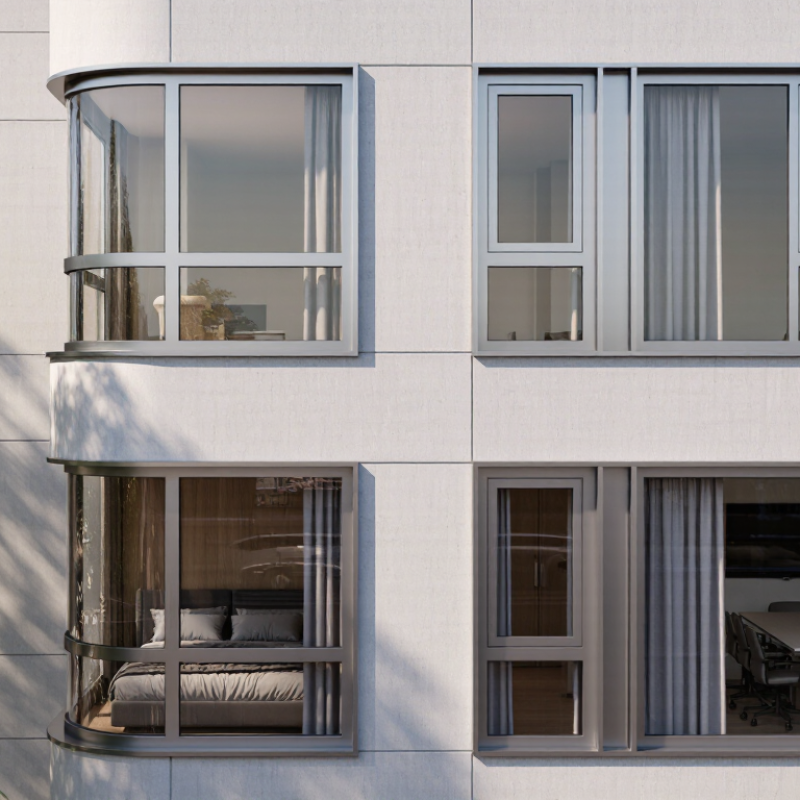
Top Soundproof Aluminium Windows Suppliers Worldwide

What Makes Aluminium Windows Effective at Blocking Outside Noise

Aluminium windows can reduce outside noise when their frames, glass, seals, and installation work as one acoustic system. The metal itself is not the main barrier. Its strength allows slimmer frames and heavier glazing without excessive movement. A rigid sash closes more evenly, helping compression seals maintain an airtight edge. It is not magic. Traffic noise usually enters through weak points, especially vents, trickle gaps, and poorly fitted joints.

For busy streets, laminated acoustic glass is often more effective than standard single glazing. Its flexible interlayer helps soften voices, horns, and mid-to-high frequency noise. Different glass thicknesses can also reduce resonance across a broader frequency range. Insulating glass units add another barrier, particularly when the cavity width and pane combination are properly specified. Yet thicker glass alone will not fix a leaking frame. Seal the gaps. Professional suppliers should provide tested sound-reduction values, installation guidance, and clear limits for those figures.

On site, installers should check frame alignment, perimeter foam, seal continuity, and the connection between window and wall. A small opening can behave like a loudspeaker. Independent laboratory ratings are useful, but real rooms may perform differently because walls, floors, and vents also transmit sound. This is where careful measurement matters. I would question any promise of total silence; even excellent aluminium windows cannot remove aircraft vibration or structure-borne noise. A practical survey before ordering often reveals whether glazing, the frame, or another building element needs attention.

Key Features to Compare Among Global Soundproof Window Suppliers

Top Soundproof Aluminium Windows Suppliers Worldwide

When comparing global soundproof window suppliers, start with verified acoustic performance, not marketing claims. Ask for laboratory reports showing STC or Rw ratings for the complete window assembly. Glass alone does not prove performance. A strong specification usually includes laminated acoustic glass, varied pane thicknesses, and a deep aluminium frame. Check the exact glass combination. Small changes can affect traffic noise significantly.

Seals deserve close attention. Continuous gaskets and tightly engineered locking points reduce air leakage around the sash. Request air, water, and structural performance data from recognized testing laboratories. Suppliers should also explain installation requirements, including perimeter insulation and joint sealing. Even an excellent window can fail beside a poorly sealed wall. I have seen this overlooked on busy urban projects.

Reliable suppliers provide drawings, sample sections, maintenance guidance, and clear warranty terms. Compare factory quality controls, production tolerances, and experience with similar climates. A supplier serving coastal regions should address corrosion resistance, drainage, and salt exposure. Ask for recent project references, but verify them independently. No window blocks every sound. Be realistic. Extremely high ratings may require thicker glass, heavier frames, and higher costs. Some suppliers may avoid discussing these compromises, which should encourage further questions.

Top Soundproof Aluminium Windows Suppliers Worldwide - Key Features to Compare Among Global Soundproof Window Suppliers

Comparison Dimension Entry-Level Supplier Capability Mid-Range Supplier Capability High-Performance Supplier Capability What Buyers Should Verify
Acoustic Performance Approx. Rw 30–35 dB Approx. Rw 36–42 dB Approx. Rw 43–50 dB Laboratory test report for the complete window assembly, not glazing alone
Sound-Test Standard May provide basic laboratory data Testing commonly aligned with ISO 10140 or ASTM E90 Independent testing aligned with ISO 10140, ASTM E90, or equivalent national standards Test date, specimen size, installation method, frequency spectrum, and weighted rating
Aluminium Frame Design Standard hollow aluminium profiles Thermally improved profiles with multiple chambers or reinforced sections Deep, reinforced, thermally broken profiles engineered for high acoustic and weather performance Profile depth, wall thickness, thermal break width, reinforcement, and corner construction
Glazing Configuration Double glazing with standard air or gas cavity Asymmetric double glazing with laminated acoustic glass Acoustic laminated glass, asymmetric panes, wide cavity, or high-performance triple glazing Glass thickness, interlayer type, pane asymmetry, cavity width, and gas filling
Typical Glass Thickness 4–6 mm per pane 6–10 mm, often including laminated glass 8–12 mm acoustic laminated glass combined with asymmetric glazing Declared glass build-up and certified acoustic result for the selected configuration
Opening Type Sliding or basic casement systems Multi-point casement, tilt-and-turn, or lift-and-slide options High-seal casement, tilt-and-turn, fixed-light combinations, and acoustically optimized sliding systems Air leakage risk, gasket compression, hardware adjustment, and tested opening size
Air Permeability Basic sealing; performance varies by system Typically Class 3–4 under EN 12207 when properly fabricated Class 4 under EN 12207 is commonly targeted for high-performance systems Air-permeability classification and test pressure for the complete window
Watertightness Basic weather resistance Commonly Class 6A–8A under EN 12208 Class 9A or higher may be available depending on system and size Water-tightness class, test pressure, drainage design, and installation conditions
Thermal Performance Typical Uw above 2.0 W/m²K Typical Uw around 1.3–2.0 W/m²K Typical Uw around 0.8–1.3 W/m²K with suitable glazing and spacers Uw value for the actual window size, glazing, spacer, frame, and installation reference
Thermal-Break Technology May use non-thermal or limited thermal separation Polyamide thermal barrier commonly used Wider thermal barriers, insulated chambers, and low-conductivity spacers may be specified Thermal-break material, width, continuity, and condensation-control details
Sealing System Single or basic EPDM gasket arrangement Multi-point locking with dual or triple gasket seals Continuous multi-seal system with acoustically optimized compression and corner joints Gasket material, number of seals, welded or vulcanized corners, and adjustment procedure
Wind Resistance Suitable for moderate exposure and smaller openings Commonly Class C3–C5 under EN 12210, depending on design Higher resistance classes available for reinforced systems and engineered sizes Wind-load calculation based on building height, location, exposure, and window dimensions
Maximum Tested Size Usually smaller standard modules Medium and large modules subject to glass and hardware limits Large fixed, casement, and lift-and-slide units subject to engineering approval Tested dimensions, sash weight limit, deflection criteria, and delivery restrictions
Certification Documentation Product datasheet and basic compliance documents Performance reports for acoustic, air, water, and wind resistance Third-party reports, declarations of performance, engineering calculations, and installation manuals Document traceability, applicable standard, laboratory accreditation, and tested configuration
Customization Options Limited colors, glass types, and hardware choices Multiple powder-coating colors, glass combinations, and opening styles Project-specific acoustic, thermal, security, solar-control, and finish specifications Whether customization is covered by certification or requires re-testing
Finish Durability Standard powder coating for general environments Architectural-grade powder coating or anodized finish Marine-grade or enhanced coating systems available for demanding climates Coating thickness, pretreatment, applicable durability class, and warranty conditions
Installation Support General fitting instructions Installation drawings and recommended sealing details Project-specific shop drawings, acoustic perimeter-sealing details, site guidance, and commissioning support Interface between frame, wall, reveal, sill, perimeter sealant, and ventilation strategy

Note: Acoustic values are indicative specification ranges for comparison only. Final performance depends on the complete window assembly, dimensions, glazing build-up, hardware, seals, wall interface, and certified laboratory testing.

How Leading Manufacturers Design and Test Acoustic Performance

Leading soundproof aluminium window suppliers treat acoustic performance as an engineering process, not a marketing phrase.

The European Environment Agency reported that over 113 million Europeans faced harmful road traffic noise above 55 dB Lden. This pressure shapes frame design, glazing selection, and installation details.

Engineers often combine laminated acoustic glass with insulated air spaces. They also strengthen aluminium profiles to reduce vibration.

Gaskets must remain flexible and continuous around every corner. Small gaps can undermine expensive glass.

Testing follows controlled standards. ISO 10140 measures airborne sound insulation in laboratory conditions, while ISO 717-1 converts results into weighted ratings such as Rw.

Test chambers measure sound across multiple frequencies, not only one impressive number. WHO guidelines recommend keeping bedroom noise below 30 dB indoors at night for good sleep quality. That target is demanding.

A supplier should publish test conditions, glazing thickness, frame size, and installation method. Otherwise, comparisons become unreliable.

No test is perfect. Site noise, masonry joints, vents, and poor fitting can reduce performance sharply. Field checks using calibrated sound meters can expose these weaknesses.

Experienced manufacturers therefore inspect corner joints, drainage paths, and compression seals before delivery.

Some specifications still overpromise. Reflection matters. A quiet laboratory result may feel different beside a busy junction, especially when low-frequency buses pass nearby.

Regional Supplier Selection: Standards, Customization, and Support

Selecting a soundproof aluminium window supplier requires regional judgment, not attractive specifications alone. The World Health Organization’s Environmental Noise Guidelines for the European Region reported that transport noise causes over one million healthy life-years lost annually in Western Europe. This makes acoustic performance a practical health consideration, not merely a comfort feature.

Regional standards should guide supplier evaluation. European projects may require EN 14351-1 documentation, while North American buyers often request AAMA, WDMA, CSA, or NFRC evidence. ISO 10140 testing and ISO 717-1 ratings help compare airborne sound insulation consistently. Ask for complete test reports, including glass thickness, frame size, seals, and installation conditions. A high laboratory rating can disappoint on site.

Customization matters.

Effective systems may combine laminated acoustic glass, insulated glazing units, deeper aluminium profiles, and compression seals. However, heavier glass increases structural loads and may complicate replacement. That trade-off deserves honest engineering review. The U.S. Department of Energy states that windows can account for 25–30% of residential heating and cooling energy use, so acoustic upgrades should not ignore thermal performance. Suppliers should provide shop drawings, drainage details, local compliance guidance, and installation training. Post-delivery support is often the weakest link. Verify response times, spare-seal availability, warranty limits, and whether the supplier reviews installation photos. A regional partner with modest marketing may offer more dependable support than a distant exporter.

Top Soundproof Aluminium Windows Suppliers Worldwide

Regional Supplier Selection: Standards, Customization, and Support

Europe

Common reference: Rw under EN ISO 10140 and EN ISO 717-1, with product conformity commonly linked to EN 14351-1.

North America

Common reference: laboratory transmission loss under ASTM E90 and rating classification under ASTM E413 or related fenestration procedures.

Australia

Common reference: AS 2047 for windows and external glazed doors, supported by project-specific acoustic test evidence.

The chart shows commonly specified acoustic rating ranges for façade windows by market. Rw and STC are related but not directly interchangeable; final selection should use local regulations, laboratory reports, glazing configuration, airtightness, installation quality, customization capability, and after-sales support.

Installation and Maintenance Factors That Preserve Sound Insulation

Sound insulation in aluminium windows depends as much on installation as on the frame design. Experienced installers check the opening before delivery, because uneven walls can create hidden acoustic gaps. A high-performance window cannot compensate for poor alignment, damaged seals, or loose fixings. The frame should sit squarely, with suitable perimeter insulation and carefully sealed joints. Even a narrow gap can transmit traffic noise into a quiet room.

Reliable suppliers should provide tested acoustic data, installation guidance, and maintenance recommendations. Ask whether performance figures apply to the complete window system, not only the glass. On site, installers should avoid compressing drainage paths or filling cavities with unsuitable materials. I have seen excellent windows underperform after rushed fitting. That result is frustrating, but it shows why inspection matters. After installation, check the handles, gaskets, and locking points several times during the first year.

Tips: Clean seals with mild soapy water and inspect them every six months. Replace cracked or flattened gaskets promptly. Keep drainage channels clear of dust and mortar. Do not drill extra holes into the frame. Ask a qualified technician to adjust hinges when the sash becomes difficult to close. Small problems grow quickly. Record unusual noise, drafts, or vibration, then compare them with the original installation condition.

Contact Us