
Wood Panels are not one uniform product. They are engineered surfaces with different structures, strengths, and manufacturing purposes. Common categories include plywood, medium-density fiberboard (MDF), particleboard, oriented strand board (OSB), and solid wood panels. Each panel can look similar under paint, yet perform differently behind a cabinet door or beneath a roof.
The Food and Agriculture Organization’s 2022 Forest Products Yearbook reported global wood-based panel production above 390 million cubic metres. That figure shows the sector’s industrial scale and growing importance in construction and furniture. It also raises a practical question: does higher production always mean better performance? Not necessarily. The USDA Forest Products Laboratory’s Wood Handbook explains that moisture, density, bonding, grain direction, and loading conditions strongly influence panel behavior. Small details matter. A swollen cabinet edge can reveal poor material selection faster than a showroom sample.
This guide compares the main Wood Panels by composition, structural performance, surface quality, moisture response, and typical application. MDF usually offers a smooth face for painted furniture. Plywood provides layered strength and dependable screw holding. OSB delivers efficient structural capacity, especially in wall and roof systems. Particleboard remains cost-effective, but exposed edges require careful protection. Solid wood panels add natural character, although movement from humidity cannot be ignored.
Standards and technical data provide a reliable starting point. Real projects still demand judgment. A panel’s best use depends on design loads, indoor conditions, finishing methods, and budget. No single type wins every application. This comparison may simplify complex choices, but it should not replace project-specific testing or professional advice.
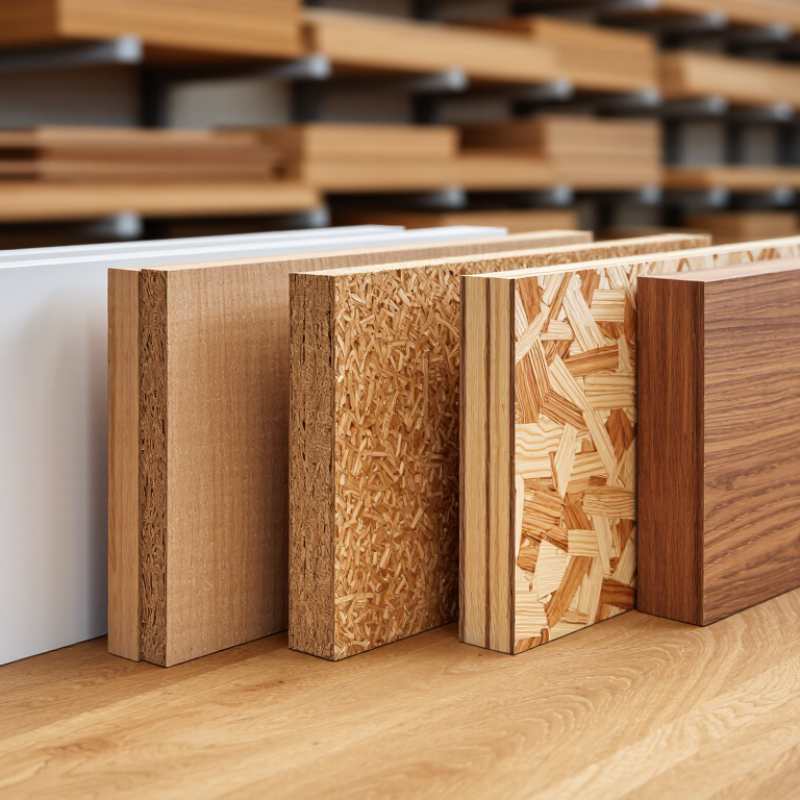
Wood panels are flat building products made from solid wood or bonded wood elements. They appear in furniture, wall lining, flooring, doors, and structural frames. Unlike rough boards, panels offer controlled thickness, width, and surface coverage. That consistency usually makes cutting and installation easier. Still, the term covers very different materials. Their performance depends on wood arrangement, drying, bonding, and finishing.
A useful classification begins with structure. Solid-wood panels are sawn or joined from natural timber pieces. Veneer panels use thin wood layers over a core, or cross-bonded layers. Plywood is one example of cross-layer construction. Particle panels press wood particles with adhesive. Fiber panels compress refined fibers into dense sheets. Strand panels arrange long flakes in oriented layers.
These structures affect stiffness, weight, screw holding, moisture response, and edge strength. A cut edge often reveals more than a label. Labels can mislead.
Panels can also be classified by intended use: interior, decorative, moisture-resistant, exterior, or load-bearing. Those categories are not interchangeable. A smooth face may hide a weak core, while a moisture-resistant sheet can still fail beside standing water. During site checks, I compare thickness, density, edge sealing, and available test documents. I once assumed two similar-looking sheets would cut alike; their edges behaved differently. That small error changed the fitting work. Small defects matter. A swollen corner, loose surface, or uneven edge may indicate poor storage or manufacturing variation. Classification guides selection, but humidity, fasteners, span, and maintenance often decide performance.
Solid wood panels are made from natural timber boards, edge-glued strips, or wider joined sections. Their grain remains visible, giving walls, doors, tables, and cabinetry a warm, tactile surface. Unlike veneer, the panel carries wood through most or all of its thickness. This allows sanding and refinishing when scratches appear. The structure still moves. Wood absorbs and releases moisture, so panels expand across the grain and shrink during dry periods. Stable indoor humidity matters. A panel installed too tightly may bow, split, or press against neighboring parts.
Panel performance depends on species, moisture content, thickness, and grain direction. Quarter-sawn boards usually move less in width than flat-sawn boards, although they can cost more. Wide panels often need breadboard ends, clips, or other movement-friendly joinery. Rigid fastening can create cracks. In kitchens and bathrooms, protective finishes reduce staining, but they do not make wood waterproof. Inspect the back and edges carefully. Small knots may be attractive, yet loose knots and end checks can weaken a working surface. Some choices look perfect initially and age poorly. That is worth admitting.
Tips: Let panels acclimate in the installation room before fitting them. Measure moisture with a meter, not by touch. Seal all exposed faces, edges, and cutouts consistently. Leave discreet clearance at walls and adjoining panels. Check seasonal movement after installation, especially around doors and large tabletops.
| Data Dimension | Typical Information | Practical Notes |
|---|---|---|
| Panel definition | A panel manufactured from natural wood boards, slabs, or glued solid-wood lamellas rather than wood fibers, veneers, or particles. | The panel retains the visual character of real wood, including grain, knots, color variation, and possible growth features. |
| Basic structure | Single-piece boards may be edge-glued into a panel. Wider panels are commonly made from several solid-wood strips joined along their edges. | The direction of the grain is generally consistent across the panel, although strip layout and joints may remain visible. |
| Common wood species | Oak, maple, beech, walnut, ash, cherry, pine, spruce, and other locally available hardwoods or softwoods. | Species selection affects hardness, density, appearance, machining behavior, cost, and resistance to wear. |
| Typical thickness | Common furniture and interior panel thicknesses are approximately 18–40 mm, although thinner and thicker panels are available. | The appropriate thickness depends on span, load, support spacing, intended appearance, and installation method. |
| Moisture content | Interior solid-wood panels are commonly conditioned to approximately 6–10% moisture content, depending on the intended service environment. | The panel should be acclimatized to the installation area because wood absorbs and releases moisture naturally. |
| Dimensional movement | Solid wood expands and contracts mainly across the grain as relative humidity changes. | Installation should allow for seasonal movement through suitable gaps, fasteners, clips, or floating-panel details. |
| Strength and stiffness | Performance varies by species, grain orientation, moisture content, panel thickness, joints, and support conditions. | Solid wood can provide good structural performance, but load-bearing applications require appropriate engineering and grading. |
| Machinability | Panels can generally be sawn, routed, drilled, sanded, and profiled using standard woodworking equipment. | Sharp tools and suitable feed rates help reduce tear-out, especially when machining around knots or reversing grain. |
| Surface finishing | Typical finishes include clear oil, wax, stain, paint, lacquer, or water-based protective coatings. | Finishing all exposed faces and edges helps provide more uniform moisture exchange and surface protection. |
| Appearance | Natural grain patterns, color variation, knots, medullary rays, and joint lines may be visible. | The appearance is unique to each panel and may change gradually with light exposure and finishing treatments. |
| Common interior uses | Tabletops, countertops, shelves, cabinet doors, workbenches, stair components, wall panels, and decorative furniture parts. | Interior applications are preferred where moisture and temperature can be reasonably controlled. |
| Common exterior uses | Covered exterior cladding, doors, outdoor furniture, and sheltered architectural details when the species, design, and finish are suitable. | Exterior exposure requires weather-resistant detailing, appropriate coating maintenance, drainage, and ventilation. |
| Main advantages | Authentic natural appearance, repairability, good machinability, potential for refinishing, and high design flexibility. | Many panels can be sanded and refinished during their service life, subject to remaining thickness and condition. |
| Main limitations | Higher moisture sensitivity, possible warping or checking, natural variation, and often greater cost than engineered wood panels. | Careful material selection, acclimatization, joint design, and regular maintenance help reduce performance problems. |
| Best selection criteria | Wood species, moisture content, panel construction, grade, dimensions, surface quality, intended location, and finish compatibility. | For responsible sourcing, verify the wood’s origin and applicable chain-of-custody or sustainability documentation. |
Engineered wood panels turn wood fibers, strands, or veneers into consistent sheets. The FAO’s Global Forest Products Facts and Figures 2023 reported global wood-based panel production near 400 million cubic metres in 2022. Plywood uses cross-laminated veneers, giving it strong directional stability. It suits cabinets, shelving, and areas needing better screw holding. MDF uses refined fibers and resin. Its smooth face accepts paint well, but exposed edges can absorb moisture quickly. Particleboard uses larger wood particles and usually costs less. It works for indoor furniture, though weak edges and water remain concerns.
Choose by load, humidity, and surface finish. Plywood is often the safer choice for a workshop shelf carrying heavy boxes. MDF creates a clean painted door with fewer visible grains. Particleboard can perform well inside a dry cabinet.
A common mistake is treating all panels as interchangeable. They are not. The USDA Forest Products Laboratory’s Wood Handbook notes that moisture changes affect wood-based materials, including dimensional movement and strength.
I have seen a perfect-looking cut swell after one damp installation. That detail deserves more attention.
Tips: Check the panel’s thickness and density before cutting. Seal exposed edges, especially around sinks or floors. Use fine-toothed blades for MDF and dust extraction during cutting. Confirm formaldehyde-emission information in the product documentation. The European Panel Federation’s technical guidance also emphasizes ventilation and responsible panel selection. Measure twice. Test one joint first.
Wood panels are not interchangeable when moisture, sound, or appearance controls the specification. Exposure-rated plywood, moisture-resistant MDF, and cement-bonded particle panels each respond differently to humidity. The USDA Forest Products Laboratory’s Wood Handbook, FPL-GTR-282, reports that conditioned interiors commonly bring wood to about 6–8% moisture content. That range matters. A panel installed too wet can shrink, open joints, or reveal fastener heads. Moisture resistant does not mean waterproof. This distinction is often missed.
For acoustic work, perforated or slatted wood panels need proper backing, an air space, and sound-absorbing infill. ASTM C423 measures absorption and reports the Noise Reduction Coefficient, or NRC. The rating applies to the tested assembly, not only the decorative face. A small installation gap can reduce performance. Quiet does not happen by appearance. I find this easy to underestimate during design reviews, especially when a textured surface looks highly acoustic.
Decorative panels bring warmth through veneer, grain, color, and texture. However, wood movement remains real. The Wood Handbook explains that tangential shrinkage is generally greater than radial shrinkage. Movement joints may prevent buckling around large feature walls. Emissions also deserve attention. Under EPA TSCA Title VI, limits include 0.05 ppm for hardwood plywood, 0.09 ppm for particleboard, and 0.11 ppm for MDF. Certificates help, but they cannot replace careful cutting, edge sealing, ventilation, and site-specific judgment.
Choosing the right wood panel starts with the project’s real demands, not its appearance. Plywood offers strong cross-grain stability for cabinets, shelving, and structural work. OSB suits wall, roof, and floor sheathing where strength matters more than a smooth surface. MDF provides a fine, uniform face for painted doors and routed details. Particleboard is economical, but it needs careful edge sealing. Veneer panels add natural character without using solid wood throughout.
Moisture changes everything. The USDA Forest Service Wood Handbook identifies moisture variation as a major cause of wood movement and panel performance problems. Bathrooms, kitchens, and exterior areas need panels rated for humid conditions. Check the technical sheet, not just the sales description. FAO forestry data recorded approximately 374 million cubic meters of global wood-based panel production in 2022, showing how widely these materials are used. However, high production does not guarantee suitability.
I review four points before specifying a panel: load, moisture, surface finish, and cutting method. A heavy countertop may need plywood, while a painted interior shelf may work well with MDF. Thin panels can sag between supports. That mistake is easy to make. In workshop testing, unsupported shelves often fail sooner than expected, even when the panel appears thick. Check span tables and screw-holding data. For indoor projects, also verify formaldehyde compliance; U.S. EPA limits include 0.05 ppm for hardwood plywood and 0.09 ppm for particleboard under TSCA Title VI. Measure twice. Then choose the panel that matches the environment.
Typical density comparison to help choose the right wood panel for each project.
The values show representative midpoints of commonly published density ranges and may vary by wood species, manufacturing process, and panel grade.
Best for furniture, doors, trim, and projects where natural grain and repairability are important.
A strong, dimensionally stable choice for cabinets, furniture, floors, and structural applications.
Suitable for wall, roof, and floor sheathing when strength and cost efficiency are priorities.
Economical for furniture cores and shelving in dry indoor environments, especially when laminated.
Ideal for painted doors, cabinetry, mouldings, and detailed machining because of its smooth surface.