
7 Best Tile Display Rack Suppliers for Global Buyers
Choosing a Tile Display Rack Supplier is about more than finding a low price. The right partner can help retailers, showrooms, and distributors present heavy samples clearly while keeping floors organized. A sturdy rack should hold tiles securely, allow easy browsing, and fit the available space. Small details matter. Smooth sample slots, stable feet, and durable finishes can make daily use simpler.
Global buyers also need to look beyond product photos. Ask about materials, load capacity, customization options, packaging, and replacement parts. Confirm dimensions before ordering; a rack that looks compact online may occupy more floor space than expected. Communication matters, too. Clear drawings, realistic production timelines, and documented quality checks help reduce surprises across long-distance orders. Still, no supplier can promise a perfect fit without understanding your samples and store layout.
This guide introduces seven tile display rack suppliers for buyers comparing product range, service, and manufacturing capabilities. It is not a universal ranking. The best choice depends on your market, budget, order volume, and display goals. Request specifications and, when practical, inspect a sample before committing to a large purchase. A little caution helps. Supplier claims deserve questions, not assumptions.
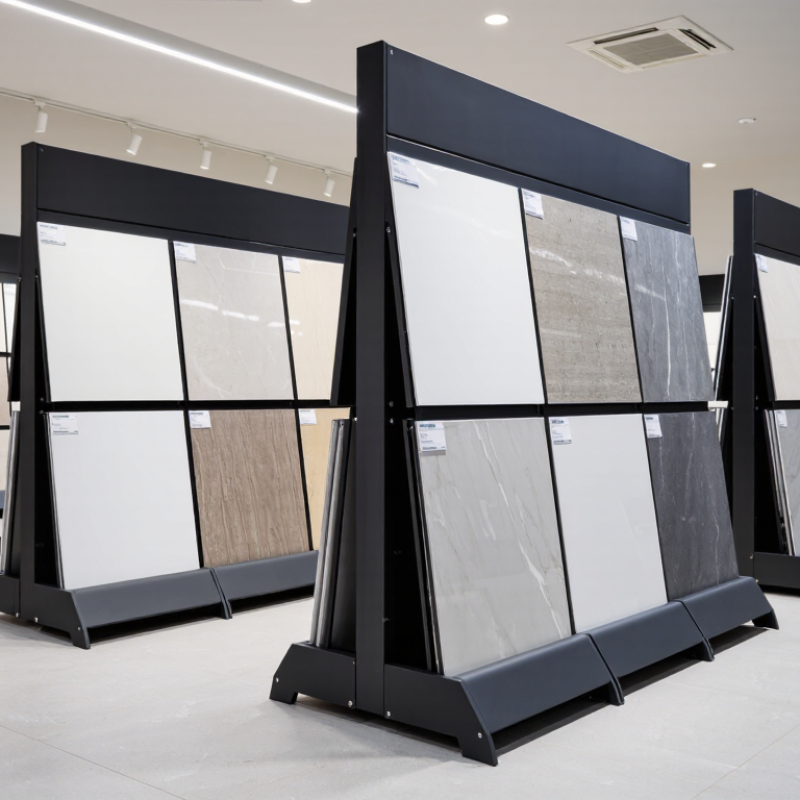
Table of Contents [Hide]
Understanding Tile Display Racks and Their Role in Global Trade
Tile display racks make heavy, flat samples easier to handle and compare. In a showroom, buyers can see surface texture, thickness, and edge finish without unpacking every carton. A useful rack stays stable when visitors pull out large panels. Its shelves should match tile dimensions and support the expected load. Small details matter: rounded edges protect samples, while clear labels help staff identify sizes and finishes.
For global trade, rack design affects more than presentation. Foldable or knock-down frames can reduce shipping volume, but suppliers should provide clear assembly instructions and secure hardware. Buyers should confirm the rack’s dimensions, materials, loading capacity, and packing method before ordering. A few centimeters can affect container planning or showroom access. Requesting photos of a fully loaded rack can reveal issues that product drawings miss.
Lighting can change how a tile’s color appears, and one sample may not represent every production batch. Not every display travels well. Ask how samples are fixed in place and whether replacement parts are available. Still, the most attractive layout is not always the easiest to update. Practical testing matters. A trial rack with actual tiles can expose awkward handling, weak supports, or labels that are hard to read.
| Supplier Category | Common Rack Formats | Best-Fit Buyer Need | Global Trade Considerations | What to Verify Before Ordering |
|---|---|---|---|---|
| Specialist display-fixture manufacturers | Tile sample boards, pull-out panels, rotating displays, and floor-standing racks | Retailers or showrooms needing fixtures designed specifically for tile samples | Custom dimensions and sample capacities can affect tooling, production time, and shipping volume. | Sample size and weight limits, loading method, stability, finish, and prototype approval process |
| Metal fabrication suppliers | Steel frames, wire racks, metal sample holders, and wheeled display stands | Buyers prioritizing a rigid structure or displays intended for frequent handling | Metal racks can be heavy; confirm packed dimensions and whether components can be shipped unassembled. | Material and coating specifications, load capacity, corrosion protection, assembly instructions, and packaging |
| Wood fixture manufacturers | Cabinets, shelving units, sample drawers, and showroom display panels | Showrooms seeking coordinated furniture-style displays or enclosed sample storage | Wood-based products may require suitable export packaging to protect corners and surfaces during transit. | Panel material, surface finish, hardware, moisture protection, packing method, and replacement-part availability |
| Plastic and acrylic fabricators | Lightweight sample holders, clear panels, brochure pockets, and compact countertop displays | Buyers needing lightweight components or clear product presentation | Protective films and edge protection help reduce scratching during handling and transport. | Material type, thickness, UV or scratch-resistance claims, safe edges, and protective packaging |
| Modular retail-fixture suppliers | Interchangeable panels, adjustable shelves, add-on sample holders, and reconfigurable frames | Retailers who update collections or need fixtures that can be rearranged | Standardized components can simplify future replenishment, but compatibility across versions should be checked. | Module dimensions, connection system, available replacement parts, assembly requirements, and compatibility |
| OEM and contract-manufacturing suppliers | Buyer-specified rack designs produced to agreed drawings or product requirements | Importers or multi-location businesses seeking repeatable specifications across orders | Clear drawings, approved samples, inspection criteria, and change-control procedures help manage cross-border orders. | Production capability, quality-control plan, tolerances, sample approval, intellectual-property terms, and lead time |
| Local or regional fixture fabricators and distributors | Locally assembled racks, stocked fixtures, and adapted display systems | Buyers who value nearby service, shorter replenishment routes, or local installation support | Local sourcing may reduce delivery distance, but product range, capacity, and total landed cost vary by market. | Stock availability, service coverage, installation options, warranty terms, and delivered cost |
| Buyer note: These are supplier categories, not a ranked list of named companies. Compare quotations using the same rack dimensions, sample load, materials, packaging requirements, order quantity, delivery terms, and inspection criteria. | ||||